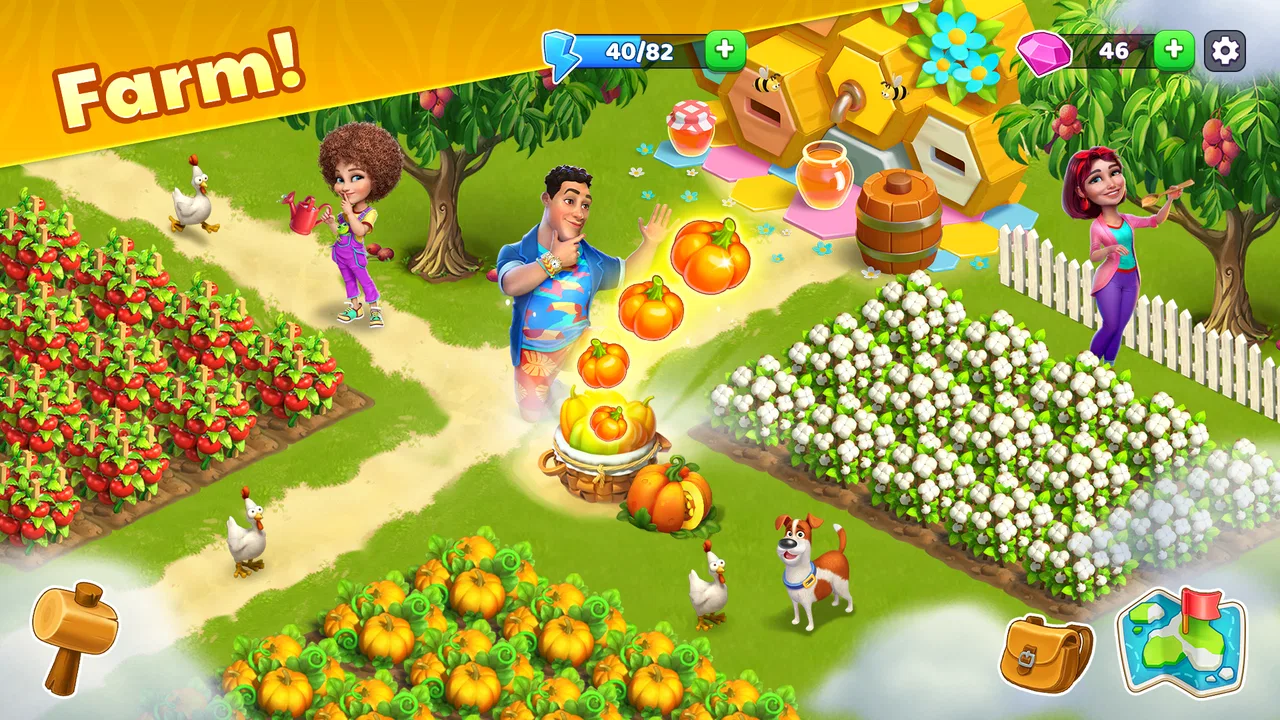
Bermuda Adventures Farm Island
- 4.5
- Rating
- 10.00M
- Installs
- Free
- Price

 Analysis by App-foxy
I spent time with Bermuda Adventures Farm Island to understand what makes its central idea work: turning a small island into a home and working farm for a growing family. That focus sounds simple, but it changes the rhythm of the whole adventure. Instead of rushing from one isolated challenge to the next, I kept returning to the same practical question: what should I build, gather, or improve so the island becomes easier and more enjoyable to live in?
This is a free adventure farming game from BELKA GAMES, and its strongest appeal is the way exploration and everyday farm tasks are tied together. I was not simply decorating a field or wandering through a story map. Progress felt more connected when a new activity gave me a reason to revisit the farm, while farm work gave the wider island a sense of purpose. That loop is the real reason I would recommend trying it, especially if you like games that can be played in short, relaxed sessions.
Why the island-and-farm combination is the real attraction
The most important capability here is the ability to develop a family home and farm while moving through an island adventure. In practice, that means the game has two moods. One is calm and routine: collecting materials, tending the farm, and improving the place where the family lives. The other is exploratory: following activities beyond the immediate home area and finding reasons to push the island story forward.
You May Also Like

 Pandora - Music & Podcasts
Pandora’s Music Is Easy to Start, but Harder to Recover
Pandora’s strength is its low-effort path from a seed to a station. Its weak spot is how much confidence it asks you to place in connection, setup, and quiet recovery.

 AccuWeather: Weather Radar
AccuWeather Review: A Quick, Clear Forecast for Everyday Decisions
For everyday plans, the best forecast is the one you can understand quickly. AccuWeather makes rain timing, radar, and local conditions easy to act on, with a few trade-offs.

 Hill Climb Racing
Why Hill Climb Racing Still Turns Crashes Into One More Run
A tiny car, a bumpy hill and one more upgrade: Hill Climb Racing keeps resurfacing because its simple chaos makes every near-miss feel personal.

 AliExpress - Shopping App
AliExpress Makes Global Shopping Feel Personal, but Shoppers Bear the Risk
AliExpress turns a global marketplace into a pocket-sized discovery engine. Its reach is useful, its shopping loop compelling, and its trade-offs easy to miss.

 Lords Mobile: Kingdom Wars
Lords Mobile Is a Kingdom-Building Routine, Not a Quick Match
A case-by-case verdict on the building, battles, device demands, and social commitments that make Lords Mobile rewarding for some players and exhausting for others.

 PDF Scanner app - TapScanner
TapScanner Makes Paperwork Easier to Capture, Check, and Share
TapScanner makes scanning with a phone feel less like a rescue operation and more like a dependable step in getting work done. Its capture tools are useful, though not flawless.
More From Our News Desk
View All News


I found that contrast more effective than a purely decorative farming game. In a traditional farm-focused alternative, the pleasure often comes from optimizing crops, arranging buildings, or repeating a highly predictable daily schedule. Bermuda Adventures Farm Island gives those familiar actions a broader destination. The farm is not just the final objective; it is the base that supports the rest of the adventure.
That distinction matters if you lose interest when a farming game becomes a checklist. Here, the island setting gives the routine some context. A task feels less like an isolated transaction when it contributes to a home, a family, and the next stage of exploration. I still performed repetitive actions, but I had more reasons to care about what those actions unlocked or enabled.
The family angle also gives the setting a warmer tone than a purely individual survival game. I approached improvements as part of building a shared place rather than merely increasing a personal score. That makes the game approachable for players who prefer gentle progression over harsh survival mechanics. It is an adventure game, but its pressure is generally framed through preparation and development rather than danger alone.
At the same time, I would not describe it as a deep farming simulator. The appeal is not advanced agricultural planning or precise economic management. Its farming works best as one part of a larger loop. If you want a detailed simulation where every crop decision has a complex long-term consequence, a dedicated farming alternative will probably offer more depth. If you want farming to make an island adventure feel personal and continuous, this game is a better match.
How the core loop feels during ordinary play
My usual session began by checking what needed attention around the home and farm. I then chose a few manageable tasks before moving toward the next island activity. That order helped me avoid playing aimlessly. Rather than tapping through every available action immediately, I treated the farm as a preparation stage: take care of the obvious work, collect what is useful, and then decide whether I had enough time and resources to continue exploring.
This is where the game’s design works well on a phone. I could make progress without needing a long uninterrupted sitting. A brief check-in was enough to handle a small piece of farm development, while a longer session gave me room to follow the adventure more deliberately. The same island therefore serves both casual players and people who enjoy settling in for a more extended play period.
One useful habit is to avoid spending everything as soon as it becomes available. I found it more comfortable to keep some resources available for the next practical improvement instead of treating every new option as an invitation to upgrade immediately. That small change in approach reduced the feeling of being stuck and made the farm feel more like a place I was managing rather than a sequence of buttons demanding attention.
Another tip is to use the home area as an anchor when the wider island starts to feel busy. When several activities compete for attention, I returned to the farm, completed a few clear jobs, and then selected one direction to pursue. This prevented the game from turning into a scattered tour of unfinished tasks. It also made the relationship between development and exploration easier to understand.
The game benefits from this flexible pacing, but it also exposes one of its limitations. Players who want constant action may find the farming and building intervals too slow. The island adventure does not remove the need for routine work; it gives that work a reason to exist. If your ideal mobile game is fast, combat-heavy, or almost entirely story-driven, this will likely feel too patient.
A realistic way to fit it into a normal day
I think the best everyday scenario is a player who has a few spare moments between other responsibilities. Imagine checking the farm during a morning break, handling a couple of straightforward tasks, and then returning later to continue an island objective. In the evening, a longer session can be used to make a more meaningful improvement or explore further. The game does not need to become the main event of the day to feel rewarding.
That pattern also makes the family-home concept more convincing. The island gradually feels like a place that changes between visits, even when each individual session is modest. I liked that I could stop after a small accomplishment instead of needing to reach a dramatic conclusion every time. This is a valuable quality for mobile play, where interruptions are common and a game that punishes short sessions can quickly become tiring.
For younger players and families, the Everyone content rating makes the game easier to consider as a broadly accessible adventure. I would still suggest that adults pay attention to the purchase options before handing the device to a child. The game is free to start, but in-app items range from $0.99 to $199.99 each, so the sensible approach is to treat optional spending carefully and use device-level purchase controls when appropriate.
That spending range is not a reason to dismiss the game, but it is an important part of the experience. The free entry point lets you discover whether the island loop suits you before paying anything. My advice is to play long enough to decide whether you enjoy the routine itself. If the only satisfying moments come when progress is accelerated, the game may not be a good fit for your habits.
What exploration gains from having a farm behind it
The farm gives exploration a useful sense of continuity. In many mobile adventure games, each location can feel like a separate stage: complete the activity, collect the reward, and move on. Here, the developing home provides a persistent reason to return. I was more willing to engage with the island’s broader activities because they fed back into something familiar.
This also changes how I judged progress. I did not measure a session only by how far I had traveled. A productive visit to the farm could be worthwhile even if I had not advanced through a major adventure objective. That is a strong design choice for players who dislike feeling that every session must produce a dramatic discovery.
There is a trade-off, though. The connection between farm work and adventure can make the game feel slower than a straightforward exploration title. If you prefer moving directly from one narrative beat to another, the return to routine may interrupt your momentum. I personally found the pauses relaxing, but I can see them frustrating players who want the island to remain constantly eventful.
Compared with a conventional farm game, the island setting offers more variety in motivation but less emphasis on specialized farming mastery. Compared with a pure adventure game, it offers a stronger home base but a less urgent pace. Its identity sits between those two familiar formats, and the best experience comes from accepting that middle ground rather than expecting it to behave exactly like either alternative.
Trade-offs that become clearer after longer play
The free-to-play structure is the main practical trade-off. At first, the ability to begin without paying makes the game inviting. Over time, however, the temptation to speed up progress can become part of the decision-making. I preferred treating waiting and gradual development as normal parts of the game rather than assuming every delay should be removed.
This approach requires patience. If you are the kind of player who wants to complete every available improvement immediately, the purchase system may create pressure. The game is more comfortable when you set your own stopping points and resist turning every unfinished task into an obligation. That is not a flaw unique to this title, but it affects whether its relaxed island atmosphere remains relaxing.
Another limitation is that repetition is part of the foundation, not an occasional side activity. You will return to familiar farm responsibilities because those responsibilities support the larger loop. I enjoyed that consistency in short sessions, but longer sessions could make the routine more noticeable. Players who need constant novelty should probably choose an adventure with less emphasis on home development.
The current version is 1.19.0, and the game has been available since December 3, 2020. Those details help explain why it feels like an established mobile title rather than a brief experimental concept. It has a clear identity built around the island family home, and that identity is more important than any single isolated feature.
Device compatibility is also worth considering before installation: the game requires Android 7.0 or later. On a compatible device, I would still leave room for the possibility that a farming-and-adventure game can involve more ongoing interaction than a very simple puzzle. If your phone is older or storage is tight, it is sensible to check your available space and system version before committing to regular play.
Who will get the most from the island routine
I would recommend this game to players who enjoy visible, gradual development. If you like returning to a place and seeing it become more useful over time, the farm-and-home focus gives each visit a clear purpose. It is also a good choice for people who want an adventure that can be paused easily instead of demanding constant concentration.
It suits casual players particularly well because a session can be organized around a small number of practical goals. You do not need to master a complicated control system to understand what the island needs. The more valuable skill is deciding what to prioritize: a home improvement, a farm task, or progress toward the next adventure activity.
I also think it works for players who normally find farming games too narrow. The island setting adds a sense of movement and discovery, while the family home keeps the experience grounded. Conversely, people who normally play action adventures may appreciate the change of pace if they are willing to accept that not every visit will deliver excitement.
I would skip it if you want a serious agricultural simulation, a competitive multiplayer experience, or a fast sequence of high-intensity challenges. The game’s appeal comes from the blend of gentle management and exploration. Removing either side from that equation leaves you with a less satisfying match for your expectations.
The audience size suggests that the formula has broad appeal: the game has passed 10 million installs, with an average rating of 4.5 from around 325 thousand ratings and about 13 thousand written reviews. I do not treat popularity as proof that every player will enjoy it, but those figures do reflect a concept that has connected with a substantial mobile audience.
Small decisions that make the experience better
My first practical recommendation is to choose a short-term priority before tapping around the island. For example, decide whether the visit is mainly for farm upkeep or exploration. This sounds obvious, but it prevents resources and attention from being spread across too many unfinished activities. The game feels calmer when I give each session a simple purpose.
Second, do not judge the game by its first few minutes alone. The central strength appears when the home, farm, and island activities begin supporting one another. A quick trial can tell you whether the visual style and pacing appeal to you, but a fairer test is to see whether you enjoy returning to the same developing place.
Third, consider the game’s purchase options as a boundary rather than a requirement. I found the free starting point useful for testing my patience with gradual progress. If you are comfortable waiting and planning, you can approach the game as a long-running casual hobby. If you dislike any system that presents paid acceleration, it is better to recognize that early and move on to a fully premium alternative.
Finally, use the family home as your measure of satisfaction. The most rewarding question is not simply whether you completed another task, but whether the island feels more livable and connected than it did before. That perspective highlights what this game does differently from a standard farming title: it makes the farm part of a broader personal adventure.
My recommendation after playing
Bermuda Adventures Farm Island is at its best when treated as a relaxed island-building journey rather than a demanding simulation. Its verified capability—combining a family home and farm with adventure progression—has a real effect on play: routine work gains context, and exploration gains a place to return to. That connection is more meaningful than a simple collection of unrelated activities.
I liked the flexibility of its sessions, the approachable tone, and the way a small amount of progress can still feel worthwhile. I also think the limitations are easy to identify. Repetition, gradual pacing, and optional purchases will not suit everyone, especially players who want constant action or complete control over a traditional farm economy.
For me, the deciding question is whether you enjoy nurturing a place over time. If the answer is yes, this free adventure game is worth trying on an Android device running 7.0 or later. Start without spending, set your own priorities, and see whether the island’s rhythm fits your daily routine. If you want a game that lets you explore while giving every return visit a practical purpose, BELKA GAMES has built a convincing option; if you want speed, intensity, or deep agricultural strategy, another category of game will serve you better.
FAQs for Bermuda Adventures Farm Island
01What is Bermuda Adventures Farm Island?
Bermuda Adventures Farm Island is a casual farming and adventure game for Android and iOS. You explore tropical islands, gather resources, grow crops, raise animals, complete quests, and expand your settlement. The game combines farming mechanics with story-driven exploration, crafting, building, and character interactions, making it suitable for players who enjoy relaxed progression mixed with light adventure challenges.
02Is Bermuda Adventures Farm Island free to download and play?
Yes, Bermuda Adventures Farm Island can generally be downloaded and played for free, but it includes optional in-app purchases. These purchases may provide energy, coins, resources, special items, or faster progress. You can enjoy the main gameplay without paying, although waiting timers and limited energy can make purchases appealing. It is recommended to review your device’s payment settings before playing.
03Does Bermuda Adventures require an internet connection?
An internet connection is usually needed for Bermuda Adventures Farm Island because the game may need to synchronize progress, load events, display advertisements, and validate purchases. Some actions might appear to work temporarily while offline, but reliable access to the full experience generally requires Wi-Fi or mobile data. Playing with a stable connection also helps prevent synchronization problems or lost progress.
04What can you do in Bermuda Adventures Farm Island?
The game offers more than traditional crop farming. You can clear land, plant and harvest crops, care for animals, produce useful goods, construct and upgrade buildings, and complete tasks for the island’s characters. Exploration is also important, with new areas, resources, and story activities becoming available as you progress. Energy management and planning are key parts of the experience.
05Is Bermuda Adventures Farm Island suitable for children?
Bermuda Adventures Farm Island is colorful, family-friendly, and easy to understand, so it may be appropriate for older children and casual players. However, parents should be aware that the game can contain advertisements, social features, and optional in-app purchases. Age ratings and available content may vary by platform and region. Using parental controls and disabling unauthorized purchases is advisable for younger players.
Pros
- Relaxing farming gameplay with colorful island environments.
- Many crops
- animals
- and buildings provide varied activities.
- Story-driven quests give clear goals beyond resource collection.
- Playable offline for convenient gaming without an internet connection.
- Regular events and updates can add fresh content over time.
Cons
- Energy limits can interrupt longer play sessions.
- Progress may feel slow without spending premium currency.
- Large downloads and updates can use considerable storage.
- Some areas and features unlock only after extended play.
- Frequent tasks may become repetitive for experienced players.

Bermuda Adventures Farm Island
Gallery